Over or Under? The 1891 Patent That Launched America's Most Ridiculous Household Argument
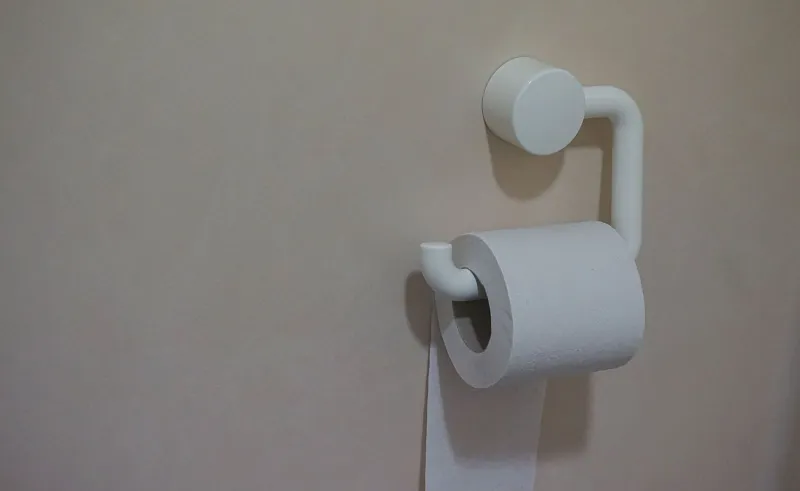
At some point in your life, you have either silently fixed someone else's toilet paper roll, been silently judged for how you loaded yours, or found yourself in a genuine argument about a cardboard tube and some perforated tissue. Possibly all three.
The "over versus under" debate is so embedded in American domestic life that relationship counselors mention it, interior design blogs have opinions about it, and a 2011 survey found that over-hangers were more likely to be assertive personalities while under-hangers leaned toward easygoing. A roll of toilet paper, somehow, became a personality test.
But here's the part nobody tells you: the whole thing was settled in 1891. There's a patent drawing that shows exactly how the inventor intended it to hang. And the reason it became a cultural flashpoint has almost nothing to do with the paper itself.
The Man Who Patented the Roll
Before the late 1800s, toilet paper as Americans know it didn't really exist. People used whatever was available — catalog pages, newspaper, leaves. In 1857, a New York entrepreneur named Joseph Gayetty began selling "Medicated Paper" in flat sheets. It didn't exactly take off.
The perforated roll format — the one that actually won — was developed by Seth Wheeler, an Albany, New York inventor who ran the Albany Perforated Wrapping Paper Company. On December 22, 1891, Wheeler was granted U.S. Patent No. 465,588 for an "Improvement in Wrapping or Toilet Paper Rolls."
The patent drawing is clear. The paper feeds over the top of the roll, hanging forward toward the user. Wheeler's illustration leaves no room for interpretation.
Case closed, right? Not even close.
How Hotels Made It a Status Symbol
The toilet paper roll reached mainstream American homes gradually through the early 1900s, but it became a cultural fixture first in hotels — specifically the kind of upscale hotels that were trying very hard to signal refinement and attention to detail.
Luxury properties in cities like New York, Chicago, and San Francisco began standardizing their bathroom presentation as part of a broader hospitality movement. Towels were folded precisely. Soap was positioned just so. And toilet paper was hung in the "over" position, with the loose end sometimes folded into a neat triangular point — a practice that persists in hotel bathrooms to this day.
That triangular fold became a quiet signal: this bathroom has been freshly prepared. Someone cared enough to touch every detail. The "over" orientation was part of that visual language. It made the roll look deliberate, tidy, and attended to.
For middle-class American households trying to bring a little hotel elegance into their own bathrooms, "over" became the aspirational default. It was, in a small but real way, a class marker.
So Why Does "Under" Exist?
If "over" was the standard, the inventor's intention, and the hotel industry's preference, why did "under" ever become a thing?
A few reasons, and they're more practical than you might expect.
Households with small children or curious pets quickly discovered that a roll hung "over" could be unspooled in seconds — one swipe of a toddler's hand or a cat's paw and you've got a pile of tissue on the floor. Hanging the roll "under" creates more friction and makes the dramatic unspooling significantly harder. For parents and pet owners, "under" wasn't a design preference. It was damage control.
There's also a space argument. In small bathrooms where the roll hangs close to a wall, "under" keeps the loose end tucked back and out of the way. It's tidier in tight quarters.
These are genuinely reasonable arguments. They just never made it into the patent.
When the Internet Turned It Into a War
For most of the 20th century, the over-versus-under question was a minor domestic quirk — the kind of thing couples teased each other about but didn't lose sleep over. Then the internet arrived.
Online forums, relationship advice columns, and eventually social media transformed the toilet paper debate into something weirdly serious. BuzzFeed ran polls. Reddit threads ran for hundreds of comments. A paper published in the journal Perceptual and Motor Skills actually studied the relationship between personality type and roll orientation. (Over-hangers, for the record, were found to be more likely to believe they're in charge of their relationships.)
The debate became a proxy for something larger — a light, low-stakes arena for arguing about control, standards, and who gets to decide how a shared household runs. It's trivial enough that nobody feels truly threatened, but just concrete enough that people have actual opinions. That's a rare and potent combination for the internet.
The Fold That Never Went Away
Meanwhile, hotels never stopped doing the triangular fold. It's now so universal that travelers barely notice it anymore — except when it's absent, which somehow feels like a downgrade. A bathroom without the folded point feels less prepared, less cared for.
That's a remarkable amount of cultural weight to hang on a piece of tissue paper. But that's what happens when a functional product gets adopted by an industry obsessed with signaling quality. The gesture outlasted its original meaning and became a tradition in its own right.
Seth Wheeler just wanted a better way to dispense paper in the bathroom. He drew it clearly, patented it properly, and moved on. He almost certainly never imagined that 130 years later, his little roll would still be causing arguments at kitchen tables across America.
But here we are. Over. Obviously.