The Keyboard Layout Designed to Slow You Down — And Why You're Still Using It
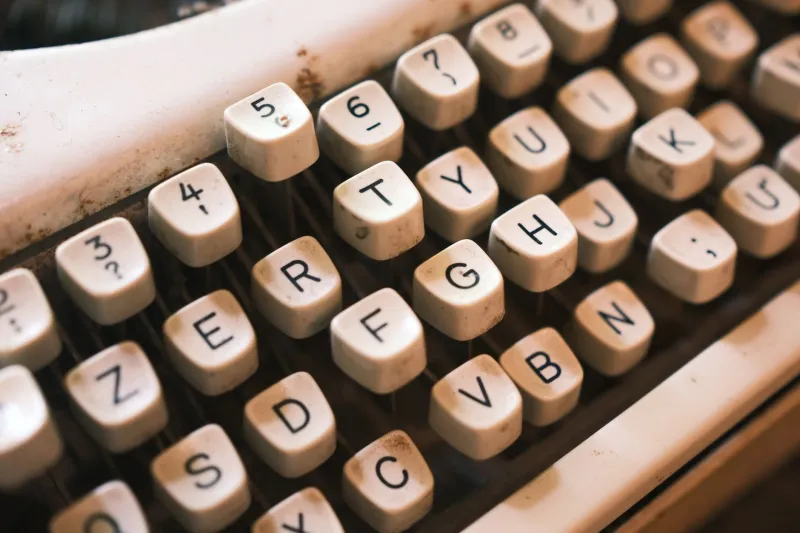
Every time you sit down to send an email, text a friend, or bang out a work report, your fingers trace a path across keys arranged in a pattern that was never meant to make you fast. The layout was engineered to make you slower. And somehow, 150 years later, it's still the only arrangement most Americans have ever used.
Welcome to QWERTY — the most successful design flaw in the history of technology.
The Typewriter's Dirty Little Problem
In 1868, a Wisconsin newspaper editor and amateur inventor named Christopher Latham Sholes was wrestling with a machine he'd been tinkering with for years: a mechanical typewriter. By 1873, he'd partnered with the gun manufacturer E. Remington and Sons to bring it to market. There was just one stubborn engineering headache standing in the way.
The early typewriter worked by swinging small metal arms — called typebars — up to strike an ink ribbon against paper. Each typebar represented a letter. When a typist moved quickly, adjacent typebars would collide mid-swing and jam together in a tangled metal mess. The faster you typed, the worse it got.
Sholes and his collaborators tried various fixes. The solution they landed on wasn't to improve the mechanism — it was to rearrange the keyboard so that commonly paired letters were placed far apart from each other. By spreading out the letters you'd naturally reach for in sequence, you forced the typist's hands to slow down just enough to let the typebars reset between strikes.
The layout that emerged from this workaround became the QWERTY keyboard. It was, in the most literal sense, a speed limiter built into the design of the machine.
The Layout Goes to Market
Remington began selling the Sholes & Glidden typewriter in 1874, and the QWERTY arrangement came standard. Early sales were slow — the machine was expensive and many businesses didn't see the point. But as the typewriter industry grew through the 1880s and 1890s, a generation of professional typists learned their craft on QWERTY keyboards. Typing schools opened. Competitions were held. Speed records were broken — all on the same layout.
By the time the typewriter became standard office equipment in the early 1900s, QWERTY was simply what a keyboard looked like. Millions of people had trained their muscle memory around it. Entire industries had organized themselves to support it.
The mechanical problem it was designed to solve? That had long since been fixed with better engineering. But nobody changed the keyboard.
Someone Actually Built a Better One
In 1936, a University of Washington professor named August Dvorak patented an entirely new keyboard layout. He'd spent years studying the mechanics of typing — which fingers were strongest, how often each letter appeared in English, which hand combinations felt most natural. The result was the Dvorak Simplified Keyboard, which placed the most common vowels and consonants directly on the home row, where your fingers rest by default.
Studies suggested Dvorak typists made fewer errors and experienced less hand fatigue. During World War II, the U.S. Navy ran a retraining program on Dvorak keyboards and reportedly found that the productivity gains paid for the training costs within days.
None of it mattered. The world was already too deep into QWERTY.
Office managers weren't going to retrain their secretarial pools. Typewriter manufacturers weren't going to retool their production lines. Schools weren't going to rewrite their curricula. The cost of switching — across millions of people, machines, and institutions — was simply too high, regardless of what the efficiency numbers said.
The Computer Didn't Fix It Either
When computers arrived in offices through the 1970s and 1980s, here was a genuine opportunity for a clean break. The mechanical typebar problem was completely irrelevant to a digital keyboard. There was no physical reason on earth to keep QWERTY.
And yet every major computer manufacturer — IBM, Apple, Microsoft — shipped their machines with QWERTY keyboards as the default. Why? Because the people buying the computers already knew how to type on QWERTY. Asking them to relearn would have been a barrier to adoption. The path of least resistance ran straight through a 100-year-old design compromise.
Today, your smartphone offers QWERTY as its default keyboard. Voice recognition and autocorrect have quietly reduced how much precision typing actually matters, but the layout endures. You can download Dvorak keyboard apps. You can switch your settings. Almost nobody does.
What QWERTY Really Teaches Us
Technologists have a name for what happened here: path dependency. It describes situations where an early decision — even a flawed or arbitrary one — becomes self-reinforcing over time because too many other things have been built around it. Switching costs compound. Inertia wins.
QWERTY is probably the most famous example in the world, but it's far from the only one. The dimensions of railroad tracks, the layout of electrical outlets, the format of spreadsheet software — history is full of cases where the first solution became permanent not because it was best, but because it arrived first and stuck.
Sholes designed his keyboard layout to stop metal arms from tangling in a machine that no longer exists. The problem it solved disappeared before most of our grandparents were born. The solution, somehow, is still here — right under your fingers.
Next time your wrists ache after a long day of typing, you have a 19th-century mechanical engineering headache to thank.