The Metal Box That Nobody Wanted — And Then Rewired Every Store in America
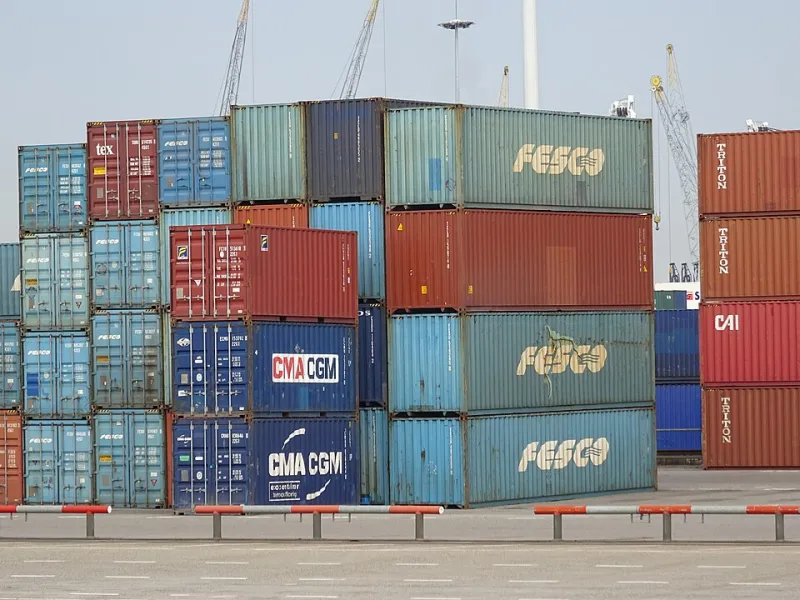
Photo: AgainErick, CC BY-SA 4.0, via Wikimedia Commons
There is a piece of infrastructure so common, so thoroughly embedded in the landscape of modern American life, that most people have never once stopped to think about it. You've seen them stacked at ports, rolling down highways on flatbeds, rusting in rail yards. You've driven past them a thousand times.
The standard shipping container. A metal box, roughly 20 or 40 feet long, built to a uniform specification.
It doesn't look like a revolution. That's the point.
The Man With a Truck and a Bad Idea
In the early 1950s, Malcom McLean was running a successful trucking company in North Carolina. He wasn't an engineer or a shipping theorist. He was a freight hauler who had built his business from a single second-hand truck into one of the largest trucking operations on the East Coast.
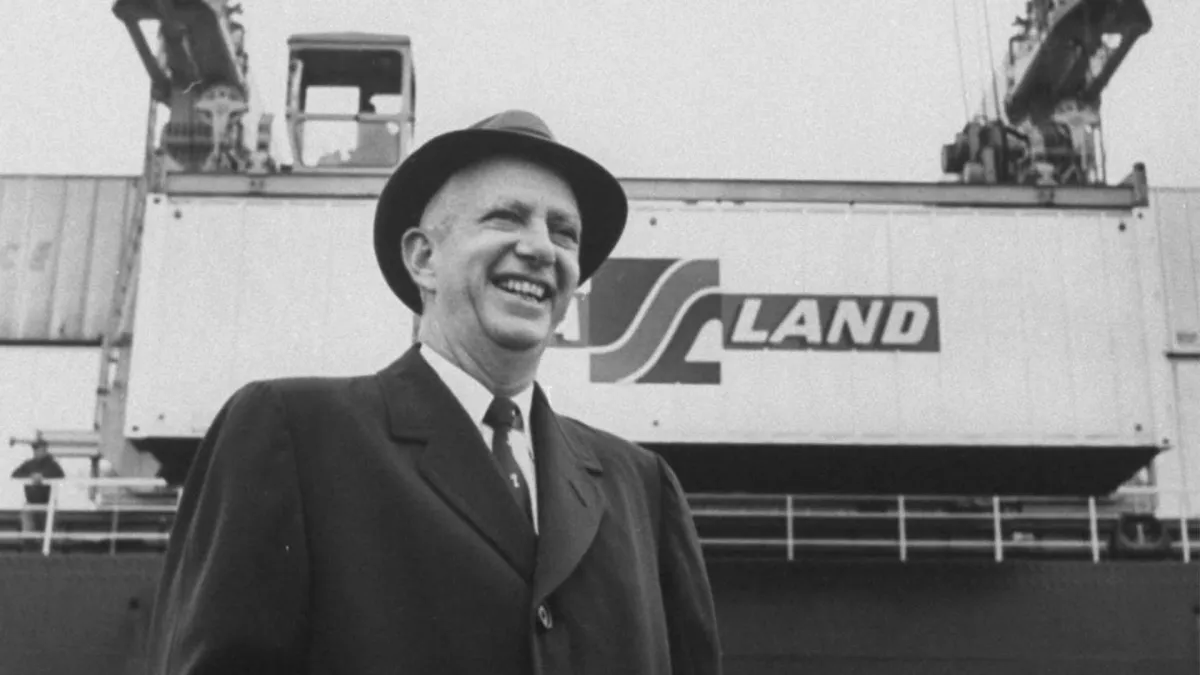 Photo: Malcom McLean, via www.esciupfnews.com
But McLean had a problem he couldn't stop thinking about. Every time his trucks needed to move cargo by ship — a common enough requirement along the Atlantic coast — the process was absurdly inefficient. Dock workers, known as longshoremen, would unload individual crates, barrels, and sacks from the truck, carry them into a warehouse, sort them, then carry them back out and load them piece by piece into a ship's hold. The same process ran in reverse at the destination.
This method, called break-bulk shipping, had been standard practice for literally thousands of years. It was slow, expensive, and prone to damage and theft. McLean calculated that loading and unloading costs ate up a staggering share of the total shipping expense — sometimes more than the actual voyage itself.
His solution was almost insultingly simple: what if you just put the cargo in a big metal box, and moved the box?
Everyone Said No
When McLean began pitching his containerization idea in the early 1950s, the response from the shipping industry was somewhere between skepticism and outright hostility.
Port authorities pointed out that their entire infrastructure — cranes, warehouses, loading docks — was built for break-bulk cargo. Retrofitting would cost a fortune.
Shipping companies argued that standardized boxes would waste space on vessels carrying oddly shaped cargo.
Longshoremen's unions saw the plan for exactly what it was: a technology designed to eliminate their jobs. Tens of thousands of workers whose livelihoods depended on the labor-intensive break-bulk system had every reason to resist.
Even other trucking executives thought McLean had lost his mind. He was proposing to spend enormous sums redesigning an entire industry around a hypothetical efficiency gain that nobody had ever actually measured.
McLean bought a small shipping line anyway, modified two surplus tanker ships to carry his containers, and on April 26, 1956, loaded 58 metal boxes onto the Ideal X in Newark, New Jersey. The ship sailed to Houston. The boxes were unloaded.
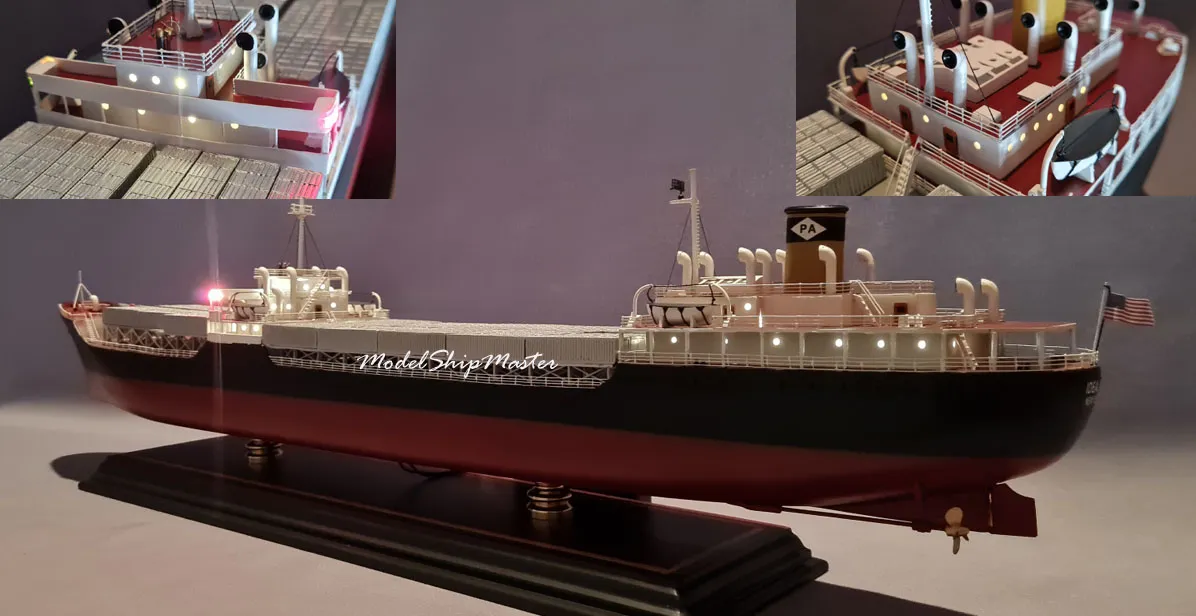 Photo: Ideal X, via modelshipmaster.com
The cost per ton of cargo moved: $0.16, compared to the $5.83 per ton that break-bulk loading typically cost.
That number changed everything.
The Slow Avalanche
Adoption wasn't instant. The industry took years to fully commit, partly because containerization only works when everyone uses the same size box — which required international standards negotiations, port infrastructure investment, and the gradual obsolescence of an entire workforce.
The International Organization for Standardization eventually codified the container dimensions that McLean had pioneered, making them a global specification. Ports in Europe, Asia, and eventually everywhere else began building the enormous gantry cranes and flat storage yards that container shipping required.
By the 1970s, the transformation was undeniable. Shipping costs had dropped so dramatically that the economics of global manufacturing had fundamentally shifted.
The Walmart Effect Has a Hidden Parent
Here is the part of the story that most Americans don't connect: the reason your television, your running shoes, your kitchen appliances, and roughly half the contents of your home were manufactured overseas isn't primarily about labor costs. It's about shipping costs.
Before containerization, moving a manufactured good from a factory in Asia to a store shelf in Ohio was expensive enough that domestic production could compete on price even with much higher American wages. The container erased that advantage. Suddenly, the wage differential between an American factory worker and a worker in South Korea or later China became the dominant economic variable — because the cost of moving the finished product across an ocean had collapsed to almost nothing.
This is the invisible engine behind the rise of big-box retail. When Sam Walton was building Walmart's supply chain in the 1970s and 80s, he wasn't just leveraging cheap overseas labor. He was leveraging the infrastructure that Malcom McLean had spent two decades forcing into existence. Just-in-time inventory — the system where stores carry minimal stock and replenish constantly from overseas suppliers — only works because containers made frequent, predictable, low-cost ocean freight possible.
The big-box store model, the Amazon warehouse, the fast fashion cycle, the electronics upgrade treadmill — all of it runs on the assumption that moving physical goods across the planet is cheap. That assumption was not always true. It became true because of a box.
What the Box Cost
It would be incomplete to tell this story without noting what containerization dismantled along the way. The longshoremen's unions were right to be worried. Port employment collapsed in city after city. Waterfront communities that had been built around the labor of break-bulk shipping — in Brooklyn, Baltimore, San Francisco — lost their economic foundation almost overnight.
The manufacturing jobs that moved overseas in the decades after containerization represent millions of American workers whose livelihoods were reshaped by an efficiency that benefited consumers and corporations far more than it benefited them.
The box didn't create inequality. But it moved it around in ways that are still playing out.
The Box You Never Think About
Malcom McLean died in 2001, wealthy and largely uncelebrated outside of logistics circles. The Economist called him one of the most important figures of the 20th century. Most Americans have never heard his name.
But the next time you pull something off a store shelf and notice the price — the almost implausible cheapness of manufactured goods in the modern American economy — you're looking at his legacy. Packed into a standard metal box, loaded by a crane, and shipped across an ocean for sixteen cents a ton.