Why American Bathrooms Are White: The Germ Theory That Sold a Color
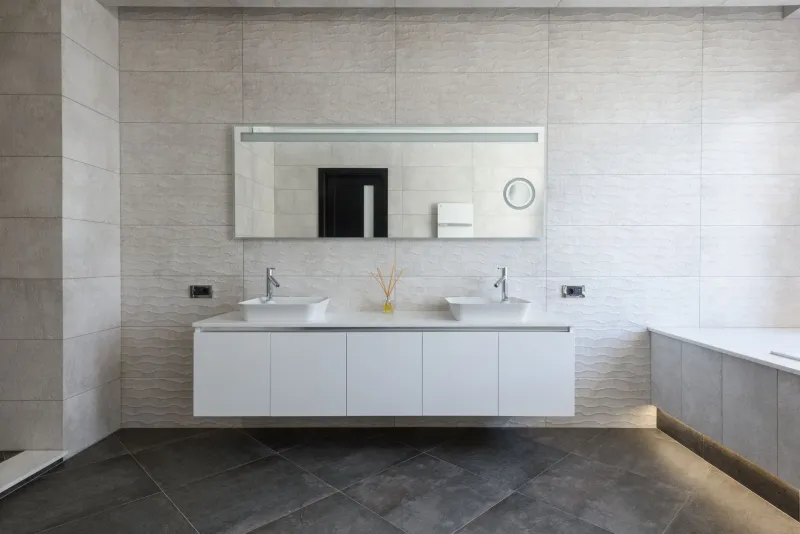
Open any home renovation magazine. Scroll through any real estate listing. Browse any tile showroom in the country. White dominates — white subway tile, white porcelain, white grout, white fixtures. Americans spend billions of dollars every year making their bathrooms look like something between a spa and a surgical suite.
Ask most people why, and they'll say something like: because it looks clean.
That answer is worth pulling apart. Because white tiles don't kill bacteria. They don't repel germs. They don't sanitize anything. The color has zero antimicrobial properties. What white does — and what it was specifically designed to do over a century ago — is look like it does all of those things.
The story of the white American bathroom is really the story of how a color became a feeling, and how a feeling became a standard nobody questions.
When Bathrooms Were an Afterthought
For most of American history, the indoor bathroom barely existed. Indoor plumbing became widespread in urban areas only in the latter half of the 1800s, and when bathrooms did appear inside homes, they were often converted closets or awkward additions — dark, cramped, and finished in whatever leftover materials were on hand. Dark wood paneling, floral wallpaper, painted tin. Nobody thought much about what a bathroom should look like, because the room itself was still a novelty.
Then germ theory arrived, and everything changed.
By the 1880s and 1890s, Louis Pasteur's and Robert Koch's work on microorganisms had filtered into American public consciousness. People learned — suddenly, viscerally — that invisible living things were making them sick. Cholera. Typhoid. Tuberculosis. The fear was real, and it was rational. Cities were genuinely dangerous places, and domestic spaces weren't much safer.
The question that followed was: how do you know if something is clean?
The Hospital Aesthetic Goes Home
Hospitals answered that question first. In the late 19th century, as germ theory reshaped medical practice, hospital administrators began demanding interiors that communicated sterility. White ceramic tiles were practical — they were durable, non-porous, and could be scrubbed down with carbolic acid without degrading. But they were also symbolic. White showed dirt. If something was white and it looked clean, you could trust it.
The visual logic was simple and powerful: white means nothing is hiding.
Manufacturers noticed. The American Radiator Company, the Standard Sanitary Manufacturing Company, and other plumbing fixture producers began marketing white porcelain tubs, sinks, and toilets to middle-class homeowners in the early 1900s. Their advertising didn't just sell products — it sold anxiety, and then sold the solution to that anxiety in the same breath.
Ads from the era warned of the dangers lurking in the unclean home. Sickness, they implied, was a housekeeping failure. And the antidote was a bathroom that looked like a hospital ward: white, gleaming, hard-surfaced, and easy to inspect.
The Architects and the Plumbers Agree
By the 1910s and 1920s, the white bathroom had become institutionalized across multiple industries simultaneously. The American Medical Association promoted domestic hygiene standards that echoed hospital design principles. Architectural pattern books for middle-class homes specified white tile as the appropriate bathroom finish. Department stores like Sears sold complete bathroom sets — tub, sink, toilet — in matching white.
The subway tile, invented in New York City for the IRT subway in 1904, crossed over into domestic use almost immediately. Its small rectangular format and bright glaze made it easy to clean and easy to inspect for dirt — which made it feel safe. It spread from subway stations to hospital corridors to restaurant kitchens to home bathrooms in the span of roughly two decades.
None of this was coordinated in any formal sense. But it reinforced itself at every level: doctors recommended it, architects specified it, manufacturers produced it, advertisers promoted it, and homeowners demanded it. White became the only acceptable color for a room associated with bodily functions and cleanliness.
What the Color Actually Does
Here's the thing that germ theory's popularizers never quite said out loud: white doesn't clean anything. A white tile covered in bacteria looks identical to a sterile one. The color communicates hygiene as a signal, not as a fact.
What white actually does is make dirt visible — which is a genuine practical benefit. You can see when a white surface needs cleaning in a way you can't with dark or patterned surfaces. But that's not the same as being cleaner. It's being more legible.
The psychological association, though, ran much deeper than legibility. By mid-century, Americans had internalized white as a proxy for safety, health, and moral order in domestic space. A bathroom that wasn't white felt somehow suspect — not just unfashionable, but vaguely threatening.
The Standard That Outlasted Its Reasoning
A century later, the white bathroom is so deeply embedded in American design expectations that deviating from it requires justification. Dark bathroom tile trends come and go, but white always reasserts itself — not because of any new evidence about its hygienic properties, but because of a set of associations laid down in the early 1900s that no one has bothered to fully examine.
The next time you're in a white-tiled bathroom, you're standing inside a piece of early 20th-century marketing. The fear that built it is long gone. The color stayed.