Slowing Down to Speed Up: The Deliberate Design Flaw Locked Into Every Keyboard You've Ever Touched
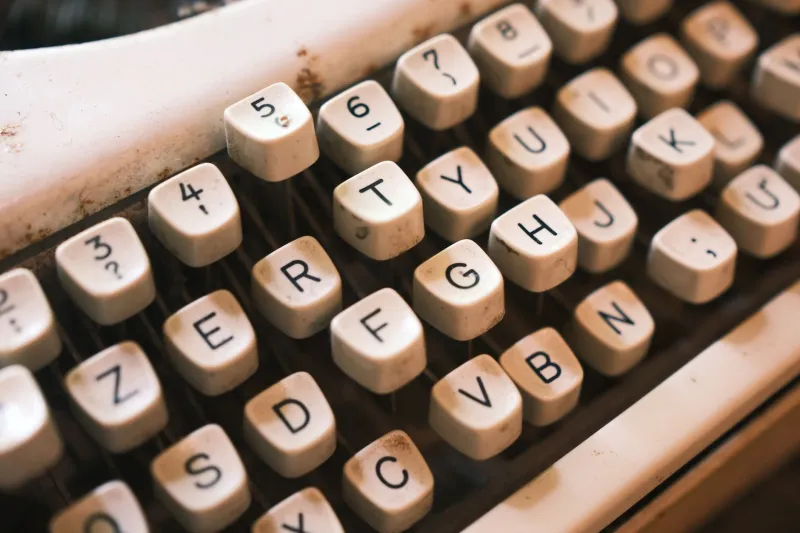
Think about the last time you typed something. An email, a text, a search query. Your fingers moved without thinking, jumping across letters in a sequence that feels completely natural. Q-W-E-R-T-Y. It's as automatic as breathing.
Now consider this: that layout was specifically engineered to make you type slower.
Not because anyone wanted you to be less productive. But because in 1873, the machines couldn't keep up with the humans — and someone had to fix that.
The Machine That Jammed
Christopher Latham Sholes was a Wisconsin newspaper editor and part-time inventor who spent the late 1860s trying to build a commercially viable typewriter. He wasn't alone — dozens of inventors were chasing the same idea — but Sholes got further than most. By 1868, he had a working prototype.
The problem was that his machine had a fundamental mechanical weakness. When two keys located close together on the type basket were struck in rapid succession, the metal arms would collide, tangle, and jam. Typists — especially fast ones — kept locking up the machine mid-sentence. The faster they typed, the worse it got.
Sholes tried redesigning the mechanism. It helped, but not enough. So he approached the problem from the other direction: instead of making the machine faster, he'd make the typist slower.
Working with educator Amos Densmore, Sholes analyzed which letter pairs appeared most frequently in English text. Then he deliberately separated those pairs on the keyboard — scattering common combinations far apart so that the typist's fingers would have to travel farther between keystrokes, buying the metal arms just enough time to reset before the next one arrived.
The result was the QWERTY layout, finalized around 1873 and licensed to Remington Arms — which had pivoted from guns to typewriters after the Civil War dried up weapons contracts. Remington put QWERTY into mass production, and within a decade, it was everywhere.
The Problem That Disappeared — But the Solution Didn't
Here's where the story turns strange. By the early 20th century, typewriter mechanics had improved dramatically. The jamming problem that QWERTY was built to solve had essentially been engineered away. Machines were faster, more reliable, and no longer needed typists to slow down.
But by then, QWERTY had already won.
Thousands of typists had trained on it. Typing schools taught it. Businesses required it. Remington had sold it into every office in America. Switching to a different layout would have meant retraining an entire workforce — and nobody was willing to pay that cost.
In 1932, a University of Washington professor named August Dvorak thought he could fix all of this. He spent years studying hand motion, letter frequency, and ergonomics, eventually designing a keyboard layout that placed the most common letters directly under the fingers on the home row. In tests, Dvorak typists consistently outperformed QWERTY typists in both speed and accuracy. The Navy ran a study during World War II that suggested retraining typists on Dvorak would pay for itself within ten days.
It didn't matter. The Navy shelved the findings. QWERTY stayed.
Locked In by Habit, Not Logic
Economists have a term for what happened: path dependence. It describes situations where an early decision — even an arbitrary or flawed one — becomes so embedded in systems, habits, and infrastructure that reversing it becomes practically impossible, regardless of whether better alternatives exist.
QWERTY is the textbook example. When computers arrived in the mid-20th century, designers had a genuine opportunity to rethink the keyboard from scratch. They didn't. They copied the layout that typists already knew, because the alternative meant retraining everyone who might buy the product.
When smartphones arrived, the same choice was made again. When tablets, when voice-to-text interfaces, when virtual keyboards — at every technological inflection point, QWERTY survived not because it was the best solution, but because it was already there.
Dvorak keyboards are still available today. You can switch your device's input settings right now. Studies continue to suggest the layout reduces repetitive strain and improves throughput. Almost nobody switches.
What a Jammed Typewriter Arm Tells Us About Change
There's something quietly remarkable about the QWERTY story. A mechanical limitation from the administration of Ulysses S. Grant has shaped how billions of people communicate in the age of artificial intelligence. The fix outlasted the problem by more than a century. The workaround became the standard.
Sholes wasn't trying to define the future of human-computer interaction. He was trying to sell typewriters without them breaking. But the layout he designed to slow typists down in 1873 is the same one your thumbs are using on your phone right now.
Next time your fingers find the keys without thinking, remember: that automatic ease isn't efficiency. It's the ghost of a mechanical jam that nobody alive today has ever seen.