The Pre-Rinse Myth: How Dishwasher Detergent Companies Accidentally Trained America to Do Extra Chores
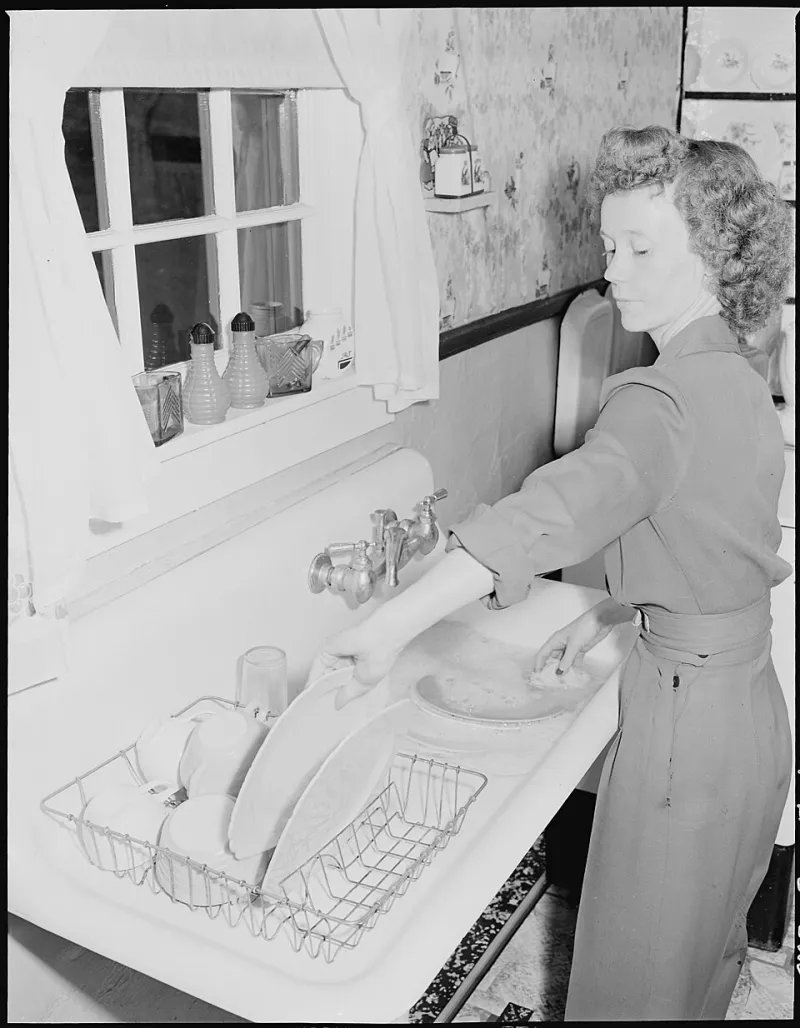
Photo: Russell Lee, Public domain, via Wikimedia Commons
Stand at the sink before loading the dishwasher tonight and ask yourself honestly: are you rinsing the plates? If you are, you're in good company. Studies suggest that somewhere between 60 and 70 percent of American dishwasher owners pre-rinse their dishes before putting them in a machine whose entire purpose is to clean dishes. It's a bit like ironing your shirt before dropping it at the dry cleaner. And the reason most of us do it has almost nothing to do with cleanliness and almost everything to do with a half-century-old marketing decision that nobody ever bothered to walk back.
The Machine That Promised Freedom
The automatic dishwasher entered American homes in earnest during the postwar boom of the late 1940s and 1950s. It was sold as liberation — a gleaming, modern appliance that would free the American housewife from the most tedious of kitchen tasks. Early ads positioned the dishwasher alongside the washing machine and the refrigerator as the holy trinity of domestic progress.
There was just one problem. Early dishwashers were genuinely not very good. The motors were underpowered, the water pressure was inconsistent, and the detergent formulations of the era — mostly basic soap compounds — struggled badly with dried or heavily crusted food. If you loaded a plate with last night's lasagna still cemented to it, there was a real chance it would come out of the machine looking roughly the same.
So appliance manufacturers and detergent brands did something sensible for the time: they told consumers to rinse first. Scrape the plate, rinse it under the tap, then load it. It was practical advice, grounded in the genuine limitations of the technology.
The Chemistry Nobody Explained
Here's where the story gets interesting. Modern dishwasher detergent — the kind reformulated and refined through the 1980s and 1990s — doesn't actually work the way most people assume. It doesn't just dissolve grease with soap. It uses enzymes.
Those enzymes — proteases, amylases, lipases — are biological compounds that break down specific types of food residue at the molecular level. Proteases attack proteins. Amylases go after starches. Lipases break down fats. They're extraordinarily effective, but they have one specific requirement: they need something to work on.
Load a pre-rinsed dish into a modern dishwasher, and those enzymes essentially have no substrate. They activate, find nothing significant to break down, and in some cases — particularly with high-efficiency, low-water machines — they can actually turn on the dish itself, leaving a chalky or etched residue on glassware over time.
Dishwasher manufacturers and detergent companies have known this for decades. Cascade began quietly updating its packaging guidance in the late 1990s. Bosch, Miele, and other appliance brands have included language in their manuals for years noting that pre-rinsing is unnecessary and can actually reduce cleaning performance. Consumer Reports ran tests confirming it. The science is not ambiguous.
And yet here we are, still rinsing.
The Habit That Outlived Its Reason
So why hasn't the behavior changed? Part of the answer is generational transmission. The mother who learned to pre-rinse in 1974 taught her daughter, who taught her son, and the habit passed down through households like a folk remedy that nobody ever thought to question. The original context — the genuinely limited machines of the early appliance era — got lost along the way. What remained was just the behavior, stripped of its reasoning.
But there's also a psychological dimension worth considering. Dishes with visible food on them feel dirty in a way that triggers a cleaning instinct before they even reach the machine. Trusting the dishwasher to handle a plate with actual food residue on it requires a small act of faith that runs against the grain of the pre-rinse habit. The machine is supposed to clean things, but putting something visibly unclean into it feels counterintuitive.
Detergent brands, for their part, never ran an aggressive campaign to undo the pre-rinse habit. There was no commercial incentive to tell consumers they could use less water and skip a step. The messaging that had embedded the behavior was never systematically reversed.
What You're Actually Wasting
The environmental math on pre-rinsing is not trivial. The average kitchen faucet runs at about 2.2 gallons per minute. A thorough pre-rinse of a full load of dishes — let's call it three minutes at the sink — uses roughly six to seven gallons of water before the dishwasher cycle even begins. Modern Energy Star dishwashers use as little as three gallons per cycle. Pre-rinsing, in those cases, uses more water than the appliance itself.
Across millions of American households, running that habit every day adds up to a genuinely significant volume of wasted water — all in service of a practice that the machines were specifically designed to make obsolete.
The Takeaway
The pre-rinse habit is a small thing, but it's a revealing one. It shows how a practical recommendation, made in a specific technological context, can outlast that context by decades — especially when no one has a strong commercial reason to correct it. The dishwasher got better. The detergent got smarter. The habit just kept going, passed from one generation to the next like inherited furniture that nobody particularly likes but nobody thinks to throw out.
Scrape the plate. Skip the rinse. The machine can handle it. That's what it was built for.