How Wartime Rationing Accidentally Invented the Drive-Thru Window
How Wartime Rationing Accidentally Invented the Drive-Thru Window
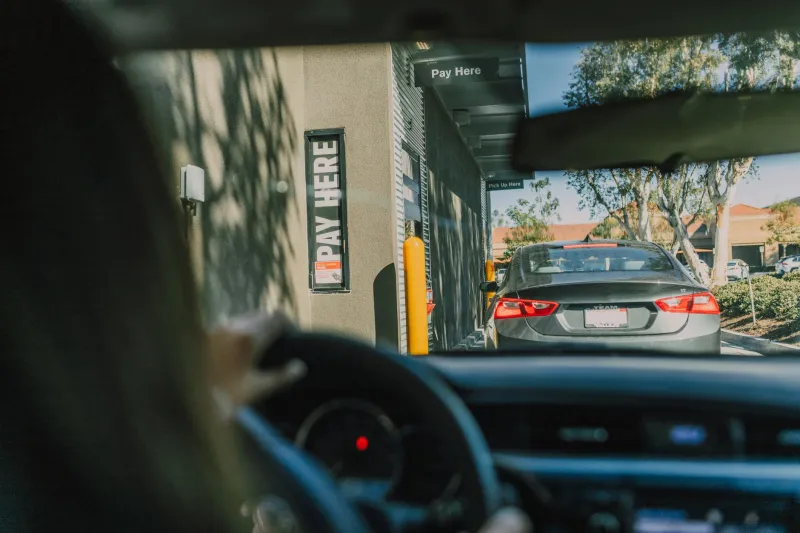
Every time you pull up to a speaker box, mumble your order into a crackling microphone, and roll forward to grab a paper bag through a small window, you're participating in one of the most American rituals ever invented. The drive-thru is so woven into daily life that it barely registers as a choice anymore. It just is. But like most things that feel inevitable, it wasn't. It took a world war, a rubber shortage, and one very resourceful hamburger stand in the Missouri Ozarks to accidentally create it.
A Country That Couldn't Drive
By 1942, the United States was fully committed to the war effort, and that commitment reached into the most mundane corners of civilian life. The federal government rationed everything from sugar and nylon to, crucially, rubber and gasoline. Tires were among the first things to go. The military needed rubber desperately, and synthetic alternatives hadn't yet scaled up to meet demand. Civilian drivers were issued ration books that strictly limited how far they could travel — and for what purpose.
Getting in your car and cruising to a restaurant wasn't exactly on the approved list. Americans who had spent the 1930s falling in love with automobile culture suddenly found themselves grounded. Drive-in restaurants, which had been booming through the late Depression years as a symbol of modern convenience, took a serious hit. The whole point of a drive-in was the leisurely experience of eating in your car in a parking lot, often with carhops skating out to your window. That kind of casual, fuel-burning outing was suddenly unpatriotic — or at least impractical.
Restaurants adapted. Foot traffic, public transit, and neighborhood dining made a quiet comeback. But the car wasn't going away. Americans had already bonded with it in a way that was almost cultural. The question wasn't whether people would go back to driving — it was what driving and eating would look like when they did.
Red's and the Window That Changed Everything
The answer came in 1947, two years after the war ended, from a man named Sheldon "Red" Chaney and his wife Julia, who ran a small hamburger stand called Red's Giant Hamburg on Route 66 in Springfield, Missouri. The postwar years were a strange, transitional moment. Americans were buying cars again at a furious pace, suburbs were spreading outward, and the old rhythms of urban dining felt slightly out of step with a country that wanted to move.
Red's wasn't trying to make history. The Chaneys were simply trying to move customers through quickly. Their solution was almost embarrassingly simple: they cut a window into the side of the building, set up a two-way speaker system so customers could order from their cars, and handed food directly through the opening without anyone having to park, get out, or wait for a carhop. You drove up, you ordered, you got your food, you left. The whole thing took minutes.
It worked. Customers loved it. The efficiency was the point, but there was also something deeply satisfying about the transaction — the sense that the restaurant had come to you, that the car was no longer just transportation but a kind of mobile dining room. Red's Giant Hamburg is now widely credited as the first true drive-thru restaurant in the United States, and the concept it pioneered was almost absurdly ahead of its time.
The Postwar Engine That Made It Explode
What turned Red's clever workaround into a national institution was the extraordinary expansion of American car culture through the 1950s. The Interstate Highway System, signed into law by President Eisenhower in 1956, began stitching the country together with high-speed roads. Suburbs grew around the assumption of car ownership. Families with two cars became common. Drive-in movies, drive-in banks, and drive-in everything reflected a culture that had decided the automobile was not just a vehicle but a way of life.
The major fast food chains recognized what Red's had demonstrated. Jack in the Box opened its first drive-thru in San Diego in 1951. McDonald's, which had already pioneered the assembly-line approach to burgers, added drive-thru service in the 1970s as competition intensified and labor costs rose. Wendy's founder Dave Thomas became an early and aggressive champion of the format, correctly betting that speed and convenience would win over American consumers in a way that table service simply couldn't match.
By the 1980s, the drive-thru wasn't a novelty — it was the default. Studies from that era showed that drive-thru sales were accounting for more than half of revenue at major fast food chains. The window had eaten the dining room.
Why It's So American
Other countries have fast food. Many have drive-thrus. But nowhere else did the concept embed itself so completely into the culture. The reasons go back to those postwar conditions — the sprawling geography, the highway infrastructure, the cultural primacy of the car, and an almost philosophical commitment to convenience as a value in itself.
The drive-thru also suited something specific about American work life. As more households had both adults working full-time jobs, the thirty-minute lunch break became sacred, and the idea of sitting down at a restaurant started to feel like a luxury. The window made eating fast not just possible but normal. It quietly redefined what a meal could be.
There's a trace-back story in every drive-thru line. The wartime shortages that disrupted American dining. The postwar hunger for speed and mobility. The Chaneys in Springfield, cutting a hole in a wall and handing a burger through it. None of them were trying to invent anything. They were just trying to solve the problem in front of them — which, as it turns out, is how most things that change the world actually get started.