When Every City Kept Its Own Time
Imagine trying to catch a train in 1882 America. You'd arrive at the station clutching a timetable that looked like a calculus textbook, filled with columns showing departure times in "Pittsburgh Time," "Columbus Time," "Local Time," and something called "Standard Railroad Time."
If you were traveling from New York to Chicago, you'd cross dozens of different time zones. Buffalo ran 32 minutes behind New York City. Cleveland was 19 minutes behind Buffalo. Detroit was 28 minutes behind Cleveland. Every city, town, and railroad junction kept its own "solar time" based on when the sun reached its highest point locally.
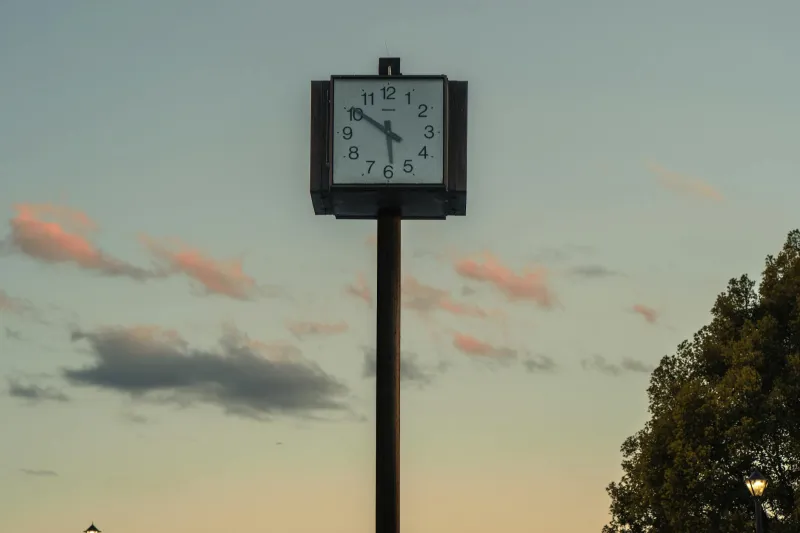
 Photo: New York, via wallpapercat.com
America had become a temporal maze that was driving railroad companies absolutely insane.
The Timetable Nightmare
By 1883, American railroads were printing schedules with over 50 different time standards. The Pennsylvania Railroad alone used six different times across its network. Station masters carried multiple pocket watches set to different local times. Missing connections became a daily catastrophe for thousands of passengers.
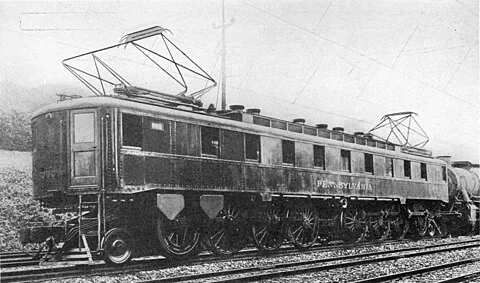 Photo: Pennsylvania Railroad, via upload.wikimedia.org
But the chaos went deeper than inconvenience. Trains were colliding because engineers couldn't coordinate schedules across time zones. The economic cost was enormous — delayed freight, missed connections, and a transportation system that seemed to get more complicated every year.
Railroad executives had been complaining about this mess since the 1870s. They'd petitioned Congress for a national time standard. They'd lobbied state governments. They'd held conferences and written reports.
Nothing happened.
So in 1883, the railroad industry decided to solve the problem themselves. Without asking permission from anyone.
The Great Time Conspiracy
The plan was breathtakingly audacious. On November 18, 1883 — a date railroad officials dubbed "The Day of Two Noons" — American railroads would simultaneously reset their clocks to four new "standard time" zones: Eastern, Central, Mountain, and Pacific.
They didn't consult Congress. They didn't ask governors. They didn't hold public hearings or seek government approval. Railroad companies simply announced that effective immediately, they were imposing a new temporal order on the United States.
The General Time Convention, representing virtually every major railroad in America, had spent months secretly coordinating this massive synchronized clock reset. They printed new timetables, trained station personnel, and prepared to flip a switch on the country's entire concept of time.
November 18, 1883: The Day America Got Synchronized
At exactly noon Eastern Time on November 18, 1883, telegraph signals flashed across the country. In cities from Boston to San Francisco, railroad station clocks were reset to the new standard times.
In some places, this meant stopping clocks for several minutes. In others, it meant jumping forward. Pittsburgh had to set its clocks back 3 minutes and 23 seconds. Augusta, Georgia jumped forward 22 minutes. Savannah fell back 36 minutes.
For the first time in American history, a train leaving New York at 3:00 PM would arrive in Chicago at a time that actually made mathematical sense.
The Rebellion That Never Came
Railroad executives had braced for massive public resistance. They expected lawsuits, political backlash, and popular revolt against corporate time tyranny.
Instead, most Americans just... went along with it.
Sure, there were complaints. The Indianapolis Sentinel called it "an attempt to change God's time." Some city governments passed resolutions declaring they would stick to local solar time. Detroit officially ignored railroad time for nearly thirty years.
But ordinary Americans quickly discovered that standardized time was incredibly convenient. Business appointments became easier to coordinate. Mail delivery became more predictable. The entire pace of commercial life smoothed out.
When the Government Finally Caught Up
What's remarkable is how long it took the federal government to officially endorse what the railroads had already accomplished. Congress didn't pass the Standard Time Act until 1918 — thirty-five years after railroad companies had unilaterally reorganized American time.
Even then, the government was mostly just ratifying what had already become reality. By 1918, virtually every American city, school, and business was operating on railroad standard time. The corporate decision had quietly become the national standard.
The Invisible Architecture of Modern Life
Today, we take time zones so completely for granted that it's hard to imagine they were once a radical corporate innovation. Every alarm clock, work schedule, TV program, and dinner reservation operates within the four-zone system that railroad barons imposed on America in 1883.
When you check your phone to see if it's too late to call someone on the West Coast, you're using infrastructure that railroad companies built without government permission. When you complain about losing an hour during "spring forward," you're participating in a system that began as corporate efficiency engineering.
The Power to Rewrite Reality
The story of American standard time reveals something unsettling about how fundamental changes actually happen. Sometimes it's not democratic deliberation or government action that reshapes society — it's a handful of industry executives who decide they're tired of dealing with inefficiency.
The railroad time zone conspiracy worked because it solved a real problem that government had failed to address. But it also worked because corporations in 1883 had the power to unilaterally reorganize something as basic as time itself.
Every time you glance at a clock, you're seeing the ghost of that November weekend when American railroad companies decided they'd had enough of temporal chaos. They drew four lines across the continent, synchronized their watches, and accidentally created the rhythm that every American life has followed ever since.
We live inside their time machine, and most of us never think about who built it.