The Napkin That Started Everything
Bernard Silver was just trying to enjoy his lunch at a Philadelphia restaurant in 1948 when his graduate school classmate Norman Woodland burst in with a problem. Woodland had been eavesdropping on a conversation between a local supermarket executive and the dean of Drexel Institute of Technology. The grocery man was desperate: checkout lines were getting longer, customers were getting angrier, and manual price-checking was killing his business.
"We need some kind of automatic system," the executive had explained, sketching rough lines on a napkin. "Something that can read product information instantly."
Woodland stared at the napkin sketch—a series of vertical lines representing different products. Most people would have seen random doodles. Woodland saw the future of commerce, though he had no idea it would take 26 years to get there.
From Beach Sand to Morse Code
Obsessed with the napkin concept, Woodland dropped out of graduate school and moved to his grandfather's apartment in Miami. He spent months walking on the beach, drawing patterns in the sand with his fingers. Straight lines, curved lines, dots, dashes—anything that might represent product information in a readable format.
The breakthrough came from an unexpected source: his Boy Scout training in Morse code. If dots and dashes could represent letters, why couldn't thick and thin lines represent numbers? Woodland extended his finger-drawn lines downward in the sand, creating the world's first barcode—a circular pattern that looked more like a bullseye than the rectangular strips we know today.
By 1952, Woodland and Silver had filed Patent #2,612,994 for their "Classifying Apparatus and Method." The patent described a system using ultraviolet light to read product codes, complete with detailed drawings of their circular barcode design. It was brilliant, revolutionary, and completely useless.
The Technology That Wasn't Ready
The problem wasn't the concept—it was 1952. The laser hadn't been invented yet. Computers were room-sized monsters that required teams of technicians. The idea of connecting checkout scanners to inventory systems existed only in science fiction.
Woodland and Silver sold their patent to Philco for $15,000, roughly $150,000 in today's money. It seemed like a fortune at the time, but they had no idea they'd just sold the rights to technology that would eventually process trillions of dollars in transactions.
For the next two decades, the barcode patent collected dust while the world slowly caught up to Woodland's beach-sand vision. Retailers continued wrestling with the same problems that had frustrated that Philadelphia supermarket executive: slow checkouts, pricing errors, and inventory nightmares.
The Railroad Experiment Nobody Remembers
The first real-world test of barcode technology happened in an unlikely place: railroad yards. In the late 1960s, the Association of American Railroads was drowning in paperwork, trying to track thousands of train cars moving across the continent. They needed a system that could automatically identify each car as trains thundered past at high speeds.
Engineers developed colored stripes that could be read by trackside scanners—essentially giant barcodes painted on the sides of freight cars. The system worked beautifully for identifying train cars, but railroad executives never imagined they were beta-testing the future of grocery shopping.
Meanwhile, laser technology had finally matured enough to make Woodland's original vision practical. The bulky ultraviolet systems described in his 1952 patent could be replaced with precise laser scanners that were smaller, faster, and infinitely more reliable.
The Grocery Store Revolution
By 1973, competing barcode standards were emerging from different companies, threatening to fragment the market before it even existed. The grocery industry realized they needed to act fast or risk ending up with incompatible systems that couldn't talk to each other.
The Universal Product Code (UPC) emerged from intense negotiations between retailers, manufacturers, and technology companies. The familiar rectangular barcode we recognize today was actually a compromise—simpler than Woodland's original circular design but more versatile than the railroad's colored stripes.
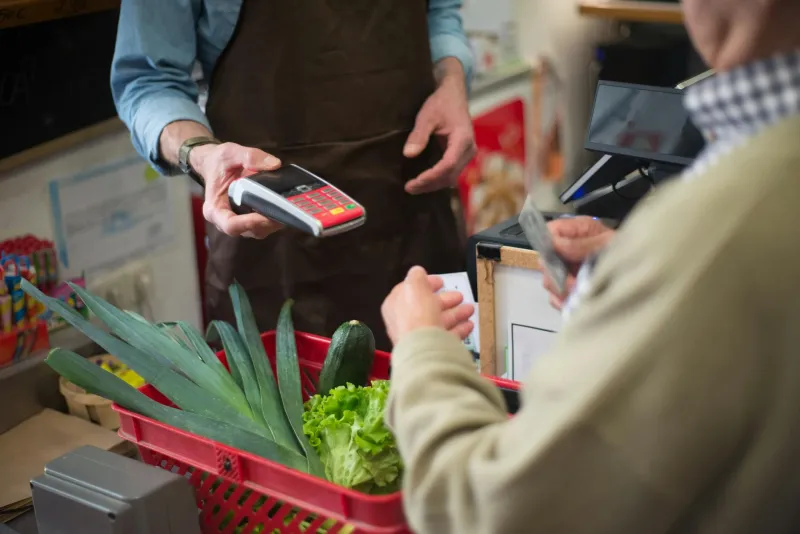
On June 26, 1974, at exactly 8:01 AM, Sharon Buchanan scanned a pack of Wrigley's Juicy Fruit gum at Marsh Supermarket in Troy, Ohio. The laser read the barcode, the computer beeped, and the cash register displayed the price: 67 cents. That beep was the sound of the modern world being born.
The Invisible Revolution
What happened next surprised everyone, including the inventors. Barcodes didn't just speed up checkout lines—they revolutionized how businesses understood their customers. For the first time in retail history, store owners could track exactly what people bought, when they bought it, and how often they came back.
Inventory management transformed overnight. Instead of manually counting products on shelves, computers could track every item from warehouse to customer. Supply chains became more efficient. Waste decreased. The entire rhythm of commerce shifted from guesswork to data-driven precision.
Manufacturers discovered they could track their products through the entire distribution chain. Retailers learned which products sold best at which times. The simple act of scanning a barcode generated information that reshaped entire industries.
Beyond the Grocery Store
Today, variations of Woodland's beach-sand inspiration appear on everything from airline boarding passes to hospital wristbands. QR codes—essentially two-dimensional barcodes—connect the physical and digital worlds. Every Amazon package, every FedEx envelope, every library book carries descendants of that 1948 napkin sketch.
The technology has become so ubiquitous that we barely notice it. That familiar beep at checkout counters soundtracks millions of transactions daily. The rectangular pattern of thick and thin lines has become one of the most recognized symbols in human history, right alongside stop signs and dollar signs.
Bernard Silver died in 1963, eleven years before the first barcode was scanned. He never saw his napkin-inspired invention change the world. Norman Woodland lived until 2012, long enough to witness barcodes evolve from grocery store novelty to global infrastructure. The beach where he drew patterns in the sand had been transformed by the very technology he'd imagined there sixty years earlier.
That Philadelphia restaurant napkin, covered in a frustrated grocery executive's rough sketches, had accidentally provided the blueprint for modern commerce. Sometimes the most revolutionary ideas start with the simplest problems: long lines, impatient customers, and someone willing to imagine a better way.