The Cold Night in 1905 That Gave America Its Favorite Summer Treat
The Cold Night in 1905 That Gave America Its Favorite Summer Treat
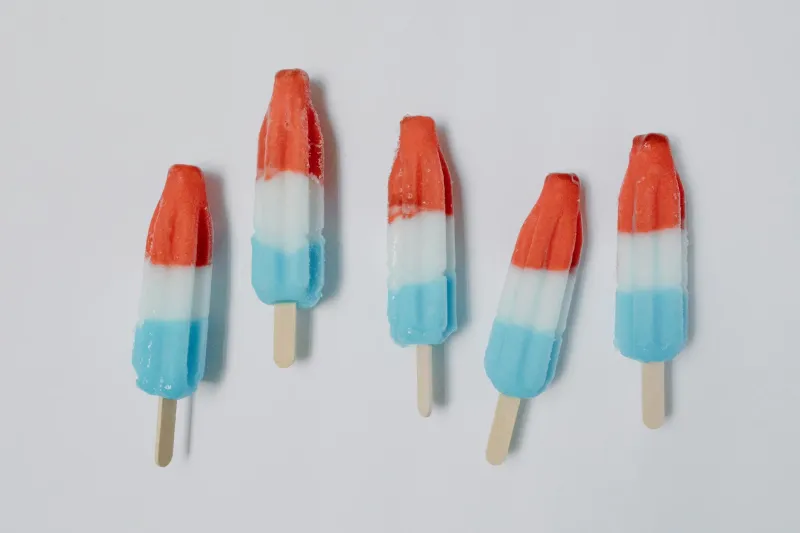
Every summer, Americans buy hundreds of millions of them. They're in gas station freezers, grocery store cases, and coolers at every backyard cookout worth attending. Kids eat them until their lips turn blue or red or orange. Adults eat them and pretend it's just because it's hot outside.
The Popsicle is so embedded in American summer culture that it barely registers as something that had to be invented. But it did have to be invented — by an eleven-year-old kid who left his drink outside by mistake and then did absolutely nothing about it for nearly two decades.
The Forgotten Cup on the Porch
The year was 1905. Frank Epperson was a kid growing up in San Francisco, and on one particular winter evening, he mixed up a drink using powdered soda and water — a fairly common homemade treat for the time — and left it sitting on his porch. He'd stuck a wooden mixing stick into the cup to stir it, the way kids do, and then forgot about the whole thing when he went inside.
San Francisco doesn't often get truly freezing temperatures, but that night was cold enough. When Frank went back outside the next morning, his drink had solidified around the stick. He pulled it out, tasted it, and apparently thought it was pretty great.
And then, as far as the historical record shows, he did almost nothing with that observation for the next eighteen years.
The Long Wait
This is the part of the Popsicle story that doesn't get told enough. Frank Epperson didn't rush to a patent office. He didn't try to sell the idea. He grew up, got a job in real estate, got married, and had kids. The frozen treat from his childhood was apparently just a memory — a cool trick he knew, something he made for his own children from time to time.
It wasn't until 1922 that the idea resurfaced in any meaningful way. Epperson, now in his late twenties, brought his frozen treats to a firemen's ball in Oakland. The response was enthusiastic enough that something clicked. He started selling them at Neptune Beach, an amusement park in Alameda, California, and the crowds went for them immediately.
The following year, in 1923, he finally filed for a patent. The original name wasn't "Popsicle" — Epperson called them "Epsicles," a mashup of his own last name and "icicle." It was his kids who started calling them "Pop's 'sicles," and that name, far catchier than anything he'd come up with himself, eventually stuck.
The Sale That Epperson Probably Regretted
The timing of Epperson's commercial push turned out to be both fortunate and, depending on how you look at it, deeply unfortunate for him personally.
His Popsicles sold well. But Epperson had made some risky real estate investments — this was the 1920s, when land speculation was running hot in California — and he found himself in financial trouble. In 1925, he sold the rights to his invention to the Joe Lowe Company, a New York-based confectionery business, for what most accounts suggest was a fairly modest sum.
The Joe Lowe Company then built Popsicle into exactly the kind of national brand Epperson had never quite managed to create on his own. They trademarked the name, ramped up distribution, and introduced the twin-stick format during the Great Depression so that two kids could split one for a nickel — a small design choice that became one of the most recognizable features of the product.
Epperson lived until 1983, long enough to watch the thing he accidentally invented as a child become a genuine American institution. He occasionally gave interviews about the origin story. Whether he was at peace with having sold the rights is a question history doesn't fully answer.
What Made It Stick
The Popsicle's timing across American history is almost suspiciously perfect. It arrived commercially just as refrigeration technology was becoming more accessible to average households and businesses. It survived the Depression by being cheap and splittable. It thrived in the postwar boom when suburban families with kids and disposable income became the dominant consumer demographic.
The product also benefited from being almost infinitely adaptable. Flavors multiplied. Shapes changed. Brands competed. Today the category includes everything from simple fruit ice pops to elaborate artisanal bars with chocolate coatings and sea salt. The word "popsicle" itself — technically still a trademark, though widely used generically — has become synonymous with the entire frozen treat format.
An Accident Worth Remembering
There's something genuinely satisfying about the Popsicle's origin story, and it's not just the accidental discovery part. It's the human scale of it. A kid. A forgotten drink. A cold night. No laboratory, no corporate research and development budget, no deliberate innovation process.
Just an eleven-year-old who left something outside and paid attention to what happened next.
The next time you pull a Popsicle out of the freezer on a hot July afternoon, you're holding the result of one of the most low-stakes accidents in American food history. Frank Epperson didn't set out to invent anything. He just forgot to bring his drink inside.
Sometimes that's all it takes.